Ah September. With it’s innate back-to-school feeling, memories of new shoes, the smell of a new pencil case, it’s a month to make you wistful. Or not, depending on if you enjoyed school.
A confession: I did not. Not very much. But I did enjoy the new shoes and the new pencil case. Whilst the shoes now may be a pair of Supergas and the pencil case might come from Muji, that feeling of a new start lingers in us all.
I’m recently back from a break in Northumberland where we visited the excellent Grace Darling museum in Bamburgh, which – although small – was full of personal items alongside the well presented biography of her short life and the actual boat used in the daring rescue. There were a number of well done, low-ish tech activities that were engaging and joyful for participants of all ages. On one where, by selecting the correct steps in preparing a lighthouse for use, you could make it light up the whole room, I saw at least 3 older adults trying to do just that: they were all laughing and enjoying themselves hugely.
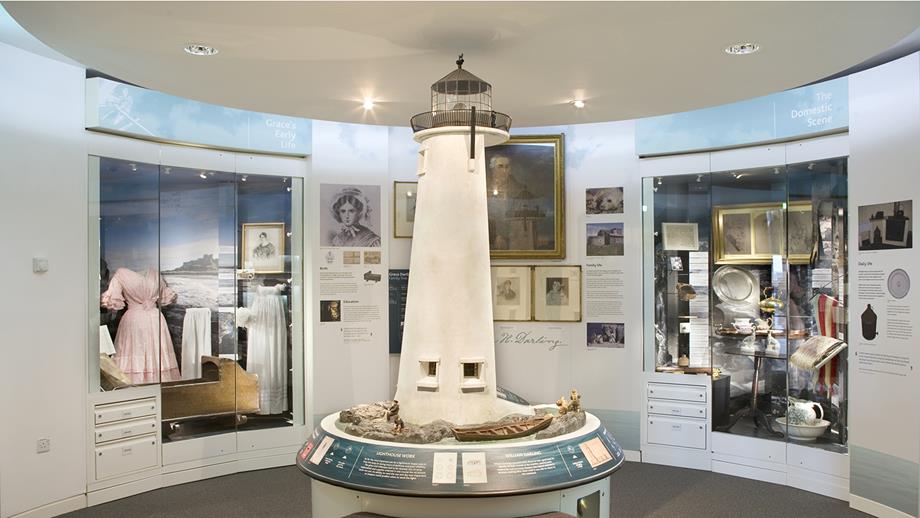
It was a lesson in how interactives can bring about joy without costing a huge fortune and without being digital, something that has been much on my mind as I’m working with a client on a reinterpretation plan.
There is a big push for digital tech in our interactives these days, and I get why. It’s often new and exciting and can be really effective. Plus, we’ve convinced ourselves that it’s only by providing lots of screens that we can get children and young people engaged.
But it can also be overly complicated, expensive to maintain and repair, and out of keeping. I’ve lost count of the number of whizzy once-new interactive touch tables that are now gathering dust with signs on them asking visitors not to touch. These were purchased in the heady days of R&D funding, only to break within 12 months of repeated use. Now, the repairs are too costly for our budgets and the tech is obsolete.

I’ve also found that it’s not the type of interactive that encourages real engagement, stimulating deeper connections than merely pressing a button will. In my work, I’m more likely to see children focused and intent on something beautifully illustrated, hands-on and creative. That lighthouse, for example. The gargoyles at Gloucester Cathedral. Pretty much anything in the ThinkTank MiniBrum gallery.
I am also more likely to see inter-generational engagement – elders working with children and young people – on an interactive that requires fine motor skills or logic steps. If you turn this wheel, these things will move. If you slot these pieces together in the right order, this will reveal itself. Automaton can be beautiful and fascinating. Where I don’t see it are on the ones where the activity is screen based.
Digital tech absolutely has its place and can be wonderful, but before we all rush to incorporate it, we really need to ask ourselves if it’s right for our museum. Better still, ask our audiences, our visitors. What do they like? Build in end-user evaluation and testing throughout. Check that it will withstand a toddler repeatedly smacking it with a beaker or an accidental spill from a water bottle! Is it easy enough for those not tech-savvy to use? Bring your grandad in to have a go!

Image credit: Collett Consultancy.
And don’t forget to check how often this software is going to need updating. How easy will it be for you to update or make changes to it, or will you have to call in the tech company each time (and pay their fees)? How long is the warranty? Can you create a budget just for the ongoing maintenance costs?
Whilst there is a temptation to think of digital tech as being “better for the environment” than standard interpretation boards or hands-on interactives, that may not necessarily be the case. They require electricity to power them (at a time of rocketing energy prices) and can be energy heavy during their production. Add to that the fact that digital tech is more likely to become obsolete and spend a longer period of time mouldering away, unused, in a cupboard, then they are very far from being carbon-neutral. Up against an activity carved from wood felled within a 10 mile radius that will last for over 5 years without additional energy requirements, the tech simply isn’t green.
There is no right or wrong way forward. The planning stage of a reinterpretation strategy is the best time to consider this, to do the research on your audience, to ask them what they like when they visit places. Go and visit other museums, take a look at what they’ve got that’s got their visitors engaged. And if your heart is set on something whizzy and new, test, test and test again!
And finally, a word on QR codes. They are absolutely the best for encouraging deep dives into the history and they fit nicely on a standard interpretation board but they are also next to useless unless you provide the free WiFi necessary to use them. People are increasingly reluctant to use their own data and, often, a mobile signal won’t get through the walls of an old building. I once spent 5 minutes trying to get a QR code to work in Worcester Cathedral before giving up on all of them. Still committed to your QR codes? Free the WiFi!
 The Collett Consultancy